8 Best Recovery Tools for Runners
Share
Hard runs leave clues. Tight calves. Heavy quads. Feet that feel beat up on the stairs. The best recovery tools for runners help you bounce back faster, move better, and keep training consistent. The right pick depends on where you get sore, how much space you have, and whether you need quick daily relief or deeper recovery after long mileage.
What makes the best recovery tools for runners worth buying?
A recovery tool should solve a real problem. It should ease soreness, improve range of motion, or reduce the stiffness that changes your stride. If it sits in a closet, it is not helping your training.
Runners also need tools that fit real life. Small apartments matter. Noise matters. Time matters. A great tool is one you can use in ten minutes after work or right after a morning run.
1. Foam roller
If you want one tool that covers the most ground, start here. A foam roller works well for quads, calves, glutes, and the upper hamstring area. It is simple, affordable, and effective for daily use.
The trade-off is pressure control. Some runners love a firm roller. Others find it too aggressive, especially on sensitive areas. A medium-density model is usually the safest starting point.
- Footprint Dimensions (folded vs. unfolded): Not foldable; about 13 x 5.5 in or 18 x 6 in
- Weight Capacity: Typically supports 250-400 lb of user body weight
- Resistance Type / Motor Horsepower: None; bodyweight pressure
- Noise Level Assessment (Crucial for apartments/upstairs): Low noise; quiet on rugs or mats, moderate on hardwood floors
Best use
Roll slowly after easy runs or later in the day. Spend 30 to 60 seconds per muscle group. Do not mash the same spot for five minutes. More pressure is not always better.
2. Massage ball
A massage ball is the small-space winner. It gets into the foot arch, glute med, hips, and outer calf better than a roller. For runners with plantar fascia tightness or hip hot spots, it often does more than bulkier tools.
It is less forgiving, though. A ball creates concentrated pressure. That makes it effective, but also easy to overdo.
- Footprint Dimensions (folded vs. unfolded): Not foldable; about 2.5-3.5 in diameter
- Weight Capacity: Usually supports 250-300 lb depending on material density
- Resistance Type / Motor Horsepower: None; bodyweight or wall pressure
- Noise Level Assessment (Crucial for apartments/upstairs): Very low noise; best used against a wall or on a mat
Best use
Use it under the foot for 1 to 2 minutes per side. For glutes and hips, lean into a wall instead of the floor if you want less pressure.
3. Percussion massager
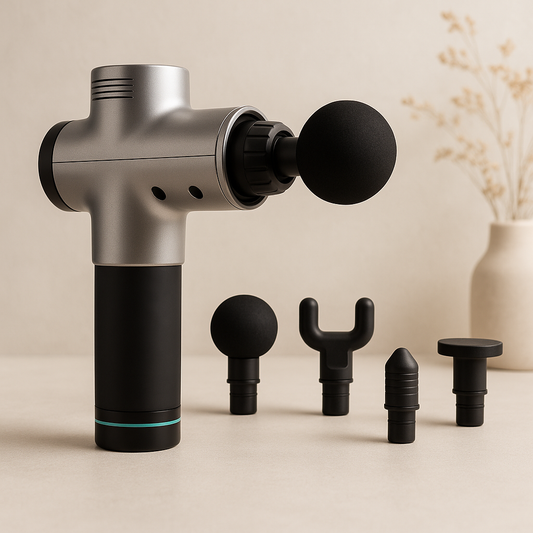
This is the fastest option for sore legs. A percussion massager can loosen calves, quads, and glutes in minutes. It is especially useful after speed work, hills, or races when muscles feel dense and tired.
But it is not perfect for every runner. Cheap models stall out. Strong models can feel intense. And some are loud enough to annoy roommates.
- Footprint Dimensions (folded vs. unfolded): Not foldable; roughly 9 x 6 x 2.5 in handheld body
- Weight Capacity: Not bodyweight-loaded; handheld use only
- Resistance Type / Motor Horsepower: Electric motor, commonly 20W-60W
- Noise Level Assessment (Crucial for apartments/upstairs): Moderate noise; quieter models run around 40-55 dB, louder ones noticeably more
Best use
Use 30 seconds to 2 minutes per muscle group. Keep it moving. Avoid bony areas, the front of the shin, and any spot that feels sharply painful.
4. Compression calf sleeves
Compression is not flashy, but it is practical. Calf sleeves are easy to wear after long runs, travel days, or hours at a desk. They help many runners manage that heavy-leg feeling, especially when recovery time is tight.
Results vary. Some runners feel a big difference. Others notice only mild support. The upside is convenience. You can recover while doing normal life stuff.
- Footprint Dimensions (folded vs. unfolded): Flat storage around 10 x 4 in; worn length usually 12-16 in
- Weight Capacity: Sized by calf circumference rather than body weight
- Resistance Type / Motor Horsepower: Graduated compression fabric; no motor
- Noise Level Assessment (Crucial for apartments/upstairs): Silent
Best use
Wear them for a few hours after a run or during travel. Fit matters more than brand. Too loose does little. Too tight is distracting.
5. Stretch strap
A stretch strap is one of the most underrated recovery tools for runners. It helps you improve hamstring, calf, and hip mobility with more control than freehand stretching. That matters when you are stiff and tired.
It is also beginner-friendly. You do not need great flexibility to use it well. You just need consistency.
- Footprint Dimensions (folded vs. unfolded): Folded about 8 x 2 in; unfolded length commonly 6-8 ft
- Weight Capacity: Usually 300-500 lb tensile strength depending on stitching and material
- Resistance Type / Motor Horsepower: Fabric or nylon tension; no motor
- Noise Level Assessment (Crucial for apartments/upstairs): Silent
Best use
Use it after a run once your breathing settles, or in the evening. Hold each stretch 20 to 30 seconds. Focus on smooth breathing, not forcing end range.
6. Recovery boots
If you run high mileage, this is the luxury pick that can earn its price. Recovery boots use sequential air compression to squeeze the legs and promote circulation. They are convenient because they are passive. Put them on, sit back, and let them work.
The downside is obvious. They cost more and take more storage space than simpler tools. For casual runners, that may be overkill. For marathon training blocks, they can be a smart upgrade.
- Footprint Dimensions (folded vs. unfolded): Folded system around 12 x 10 x 8 in plus boot sleeves; full leg sleeves often 30-40 in long
- Weight Capacity: Sized by leg dimensions, not bodyweight load
- Resistance Type / Motor Horsepower: Electric air compression pump, usually low-power motorized unit
- Noise Level Assessment (Crucial for apartments/upstairs): Low to moderate noise; generally apartment-friendly, around quiet fan level
Best use
Use for 20 to 30 minutes after long runs or hard workouts. They pair well with simple tools, not replace them. You still need mobility work.
7. Cold therapy wrap
For irritated knees, ankles, or shins, cold therapy is more targeted than full-body recovery tools. A wrap gives local relief when one area is taking the hit. That makes it useful during training blocks when small flare-ups can become bigger problems.
This is not a cure for injury. It is a support tool. If pain changes your gait, you need more than a wrap.
- Footprint Dimensions (folded vs. unfolded): Folded about 8 x 6 x 2 in; worn size varies by joint
- Weight Capacity: Not weight-rated; secured by straps or compression sleeve
- Resistance Type / Motor Horsepower: Gel pack or ice insert; no motor
- Noise Level Assessment (Crucial for apartments/upstairs): Silent
Best use
Apply after runs when a joint feels irritated or warm. Keep sessions short, usually 10 to 15 minutes, with fabric between skin and pack.
8. Acupressure mat
This is the low-effort option that surprises people. An acupressure mat can help lower-body tension indirectly by helping your whole body relax. That matters when stress, poor sleep, and general tightness are slowing recovery.
It is not as specific as a roller or ball. It is better for overall reset than pinpoint muscle work. Still, for runners who struggle to slow down, it can be a useful habit builder.
- Footprint Dimensions (folded vs. unfolded): Folded about 15 x 6 x 6 in; unfolded around 26 x 16 in
- Weight Capacity: Typically supports 250-300 lb depending on foam density
- Resistance Type / Motor Horsepower: None; bodyweight pressure
- Noise Level Assessment (Crucial for apartments/upstairs): Silent
Best use
Lie on it for 10 to 20 minutes in the evening. Start with a shirt on if the sensation feels too sharp.
How to choose the best recovery tools for runners
Buy for your weak point, not for hype. If your feet and hips are always tight, a massage ball and stretch strap make more sense than recovery boots. If your whole lower body feels cooked after workouts, a foam roller or percussion massager gives broader relief.
Use this checklist before you buy:
- Tight on space? Choose a massage ball, stretch strap, or calf sleeves.
- Need quiet gear for an apartment? Skip loud massage guns. Go with passive tools.
- Training for a race? Prioritize tools you will use 4 to 6 times weekly.
- Managing one irritated area? Pick a cold wrap over a general tool.
- Want the best value? Start with a roller plus a ball.
- Hate long recovery sessions? Choose fast options like a massage gun or sleeves.
- Need low effort? Recovery boots or an acupressure mat fit that goal.
For most runners, the smartest setup is not one tool. It is a small system. A foam roller for major muscle groups, a massage ball for problem spots, and a strap for mobility covers a lot. That mix is affordable, quiet, and easy to use at home.
Virfit's approach works best here: train smarter, recover better, stay consistent. Pick tools that match your routine, your space, and your actual soreness patterns. The best recovery plan is the one you will keep using next week.