How to Relieve Muscle Soreness Fast
Share
That stiff, heavy feeling the day after training can slow everything down. If you want to know how to relieve muscle soreness, the goal is simple: restore movement, improve circulation, and avoid turning normal soreness into a longer setback. The right recovery tools help, but timing and technique matter just as much.
How to relieve muscle soreness without losing training momentum
Most soreness after exercise is delayed onset muscle soreness, or DOMS. It usually peaks 24 to 72 hours after a new, hard, or high-volume workout. That soreness is common after strength work, sprint intervals, downhill running, or any session that adds more eccentric loading.
The fix is not complete shutdown. In most cases, light movement works better than staying still. Easy mobility, gentle walking, and low-intensity band work can increase blood flow and reduce stiffness. You are not trying to crush another workout. You are trying to help the body recover so you can stay consistent.
It also helps to separate normal soreness from pain. Soreness feels broad, dull, and tender. Pain is sharper, more localized, or changes how you move. If you have swelling, bruising, weakness, or joint pain, treat that differently and get it checked.
Start with movement, not max effort
The first move should be easy motion. Five to fifteen minutes of light activity often does more than lying on the couch. A short walk, easy cycling, or a basic mobility flow can loosen stiff tissue and reduce that locked-up feeling.
A yoga mat makes this easier because it gives you a stable recovery space at home. You can go from hip openers to thoracic rotation to calf stretching without needing much room.
Yoga mat
A mat is not just for stretching. It creates a repeatable recovery routine. That matters when consistency is the real edge.
- Footprint Dimensions (folded vs. unfolded): Rolled approximately 24 x 6 inches, unfolded approximately 72 x 24 inches
- Weight Capacity: User bodyweight dependent, typically supports 300+ pounds during floor work
- Resistance Type / Motor Horsepower: None
- Noise Level Assessment (Crucial for apartments/upstairs): Very quiet, ideal for apartments and shared spaces
If soreness is mild to moderate, try a short sequence: cat-cow, world’s greatest stretch, glute bridge holds, hamstring flossing, and ankle mobility. Keep it controlled. No aggressive forcing.
Use pressure wisely
Self-massage can help reduce soreness, but more pressure is not always better. The goal is to calm tissue and restore motion, not grind into it. If you tense up while using a recovery tool, you are probably going too hard.
For larger muscle groups, start broad. For stubborn knots, go more targeted.
Foam roller
A foam roller is one of the most reliable tools for post-leg-day soreness. It works well on quads, glutes, calves, lats, and upper back.
- Footprint Dimensions (folded vs. unfolded): Not foldable, typically 18 x 6 inches or 36 x 6 inches
- Weight Capacity: Commonly supports 250 to 400 pounds depending on density
- Resistance Type / Motor Horsepower: Bodyweight-based compression, no motor
- Noise Level Assessment (Crucial for apartments/upstairs): Low noise, apartment-friendly if used on a mat
Roll slowly for 30 to 60 seconds per area. Pause on tight sections, then breathe. Avoid rolling directly over joints or lower back bones. For very sore legs, shorter sessions usually feel better than long ones.
Massage ball
A massage ball is better when soreness hides in small areas. Think glutes, feet, front shoulder, pecs, and the outside of the hip.
- Footprint Dimensions (folded vs. unfolded): Not foldable, typically 2.5 to 5 inches in diameter
- Weight Capacity: Bodyweight dependent, generally supports full body pressure against wall or floor
- Resistance Type / Motor Horsepower: Bodyweight-based compression, no motor
- Noise Level Assessment (Crucial for apartments/upstairs): Very low noise, excellent for apartments
Use a wall when floor pressure feels too intense. That gives you more control. Small tools can be extremely effective, but they can also be too much if you press hard into already irritated tissue.
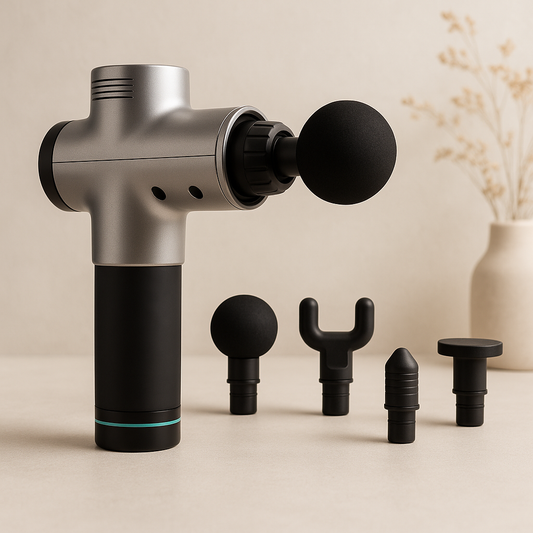
Percussion massager
A percussion massager is useful when you want quick relief without setting up a long recovery session. It works best on big muscle groups and can help after strength sessions, runs, or long workdays sitting at a desk.
- Footprint Dimensions (folded vs. unfolded): Handheld, typically 9 x 6 x 2.5 inches
- Weight Capacity: Not weight-bearing
- Resistance Type / Motor Horsepower: Battery-powered percussion motor, often 20W to 60W equivalent output
- Noise Level Assessment (Crucial for apartments/upstairs): Moderate noise, usually acceptable in apartments but not ideal late at night
Keep the device moving. Thirty seconds to two minutes per muscle group is usually enough. Do not hammer bony areas, fresh bruises, or obvious injuries. If the muscle tightens more during use, back off.
Recovery also depends on hydration, sleep, and food
This is where a lot of people miss easy wins. If you trained hard, slept badly, and barely drank water, soreness usually lasts longer. Muscles recover better when fluid balance, protein intake, and sleep quality are in place.
Hydration supports circulation and tissue function. Protein helps repair muscle damage. Carbohydrates can matter too, especially after long or intense training, because low energy availability can drag out recovery.
Sleep is the strongest lever. A fancy recovery setup cannot fully make up for short, broken sleep. If soreness keeps stacking week after week, look at your sleep schedule before buying more tools.
Active recovery beats total rest in most cases
When people ask how to relieve muscle soreness fast, they usually want permission to skip movement. Sometimes rest is right, especially if soreness is severe. But for standard DOMS, active recovery is usually the better play.
Resistance bands are ideal here because they let you move without loading the body heavily. You can do light rows, shoulder pull-aparts, glute activation, and leg extensions with almost no impact.
Resistance bands
Bands are simple, effective, and easy to use in small spaces. They are especially useful when you want blood flow without joint stress.
- Footprint Dimensions (folded vs. unfolded): Folded approximately 8 x 2 inches, unfolded length varies from 41 to 82 inches
- Weight Capacity: Load rating varies by band strength, commonly 10 to 150 pounds of resistance
- Resistance Type / Motor Horsepower: Elastic resistance, no motor
- Noise Level Assessment (Crucial for apartments/upstairs): Silent to very low noise, excellent for upstairs use
Use low resistance. Keep reps smooth and controlled. This is not the time for burnout sets. Think recovery circuit, not performance test.
Heat, cold, and timing
Heat often feels better for stiffness. A warm shower, heating pad, or light movement in a warm room can help muscles relax. Cold can reduce soreness perception for some people, especially after hard conditioning, but it may also blunt some training adaptations if overused right after strength work.
So it depends on your goal. If you need to feel better fast for daily function, cold may help. If your main issue is tightness and reduced range of motion, heat and movement often win. Neither option replaces sleep, food, or smart training progression.
Prevent the next round of soreness
The best recovery plan starts before the next workout. Sudden jumps in volume, intensity, or exercise novelty are what usually cause the worst soreness. You do not need to train softer. You need to progress smarter.
Warm up with intent. Add volume gradually. Keep technique clean when fatigue builds. If one session destroys you for four days, that session was probably too much for your current base.
Virfit’s approach fits here: train smarter, recover better, stay consistent. Recovery is not separate from performance. It is what keeps performance repeatable.
How to choose the right recovery setup
Buy based on your training style and your space. A runner or lifter with frequent leg soreness usually gets the most value from a foam roller. If your tightness is more targeted, a massage ball is the better tool. If you want fast convenience, a percussion massager makes sense. If you need a full recovery routine at home, start with a yoga mat and resistance bands.
Use this checklist before you choose:
- Pick broad-pressure tools for quads, calves, glutes, and back.
- Pick targeted tools for feet, hips, shoulders, and trigger points.
- Choose low-noise options if you live upstairs or train late.
- Prioritize compact gear if your space is limited.
- Use active recovery tools if you want to keep moving.
- Avoid high-intensity recovery methods on sharp pain or injury.
Muscle soreness is normal. Staying stuck in it is not. A few smart tools, better recovery habits, and lighter movement between hard sessions can get you feeling better faster. The real win is not just less soreness tomorrow. It is being ready to train again with confidence.