What Equipment Do I Need for Home Workouts?
Share
A home gym should solve your schedule problem, not create a storage problem. If you are asking, “what equipment do I need for home workouts,” start with tools that cover several movement patterns, stay quiet, and fit your actual floor space. You do not need a treadmill, cable machine, or garage full of plates to make progress.
A smart starter setup builds strength, core control, mobility, and recovery. Add cardio equipment only when it supports a routine you will repeat.
What Equipment Do I Need for Home Workouts?
For most people, the best first purchases are adjustable dumbbells, resistance bands, a stable workout mat, a doorway pull-up bar, and an ab roller. This setup supports squats, presses, rows, hinges, carries, pull-ups, core work, and mobility drills.
The specifications below are practical buying targets. Always verify the rating, door compatibility, and safety instructions on the exact product before training.
1. Adjustable Dumbbells for Full-Body Strength
Adjustable dumbbells deliver the most training value per square foot. They make lower-body training more challenging than bodyweight alone. They also handle presses, rows, curls, lunges, deadlifts, and loaded carries.
Choose a weight range that leaves room to grow. Beginners may start with 5 to 25 pounds per hand. Many intermediate trainees will outgrow that range quickly. A 5 to 50-pound pair is a stronger long-term target.
- Footprint dimensions: About 14.5 x 7.5 x 7.5 inches per dumbbell. Store on a tray around 16 x 8 inches. No separate folded size.
- Weight capacity: 100 pounds total working load for a pair rated to 50 pounds each.
- Resistance type / motor horsepower: Selectorized plate resistance, typically 5 to 50 pounds per hand.
- Noise level assessment: Low to moderate. Quiet during controlled reps. Use a mat and never drop them upstairs.
2. Resistance Bands for Small Spaces
Resistance bands make a small room more useful. They create pulling angles that dumbbells cannot always match. Use them for rows, pulldowns, face pulls, presses, glute work, and warm-ups.
A set with long bands, loop bands, handles, and a door anchor gives you more options. Do not buy a band set based on color alone. Resistance varies widely between brands.
- Footprint dimensions: Long bands are usually 48 inches long. A full set stores in a pouch roughly 10 x 7 x 3 inches. No unfolded floor footprint is required.
- Weight capacity: Choose a door anchor with a stated working rating of at least 300 pounds. Bands should list their tested resistance range.
- Resistance type / motor horsepower: Elastic resistance. A useful set covers approximately 10 to 150 pounds of combined resistance.
- Noise level assessment: Very low. Excellent for apartments, shared walls, and early workouts.
3. A Doorway Pull-Up Bar for Back Strength
Pulling strength is often the missing piece in home programs. A doorway pull-up bar gives you vertical pulls without a large machine. It can support pull-ups, chin-ups, dead hangs, and hanging knee raises.
Measure the doorway before you buy. Check both width and trim shape. A poor fit can damage the frame or create a safety risk. If you rent, use protective contact pads and follow the installation directions exactly.
- Footprint dimensions: Approximately 38 x 8 x 3 inches installed. Store at about 38 x 8 x 3 inches when removed.
- Weight capacity: Look for a clearly stated maximum user rating of 300 pounds or higher.
- Resistance type / motor horsepower: Bodyweight resistance. Add a band for assistance or extra resistance.
- Noise level assessment: Low when secure. Moderate if the bar shifts or contacts loose trim. Avoid kipping movements upstairs.
4. An Ab Roller for Core Control
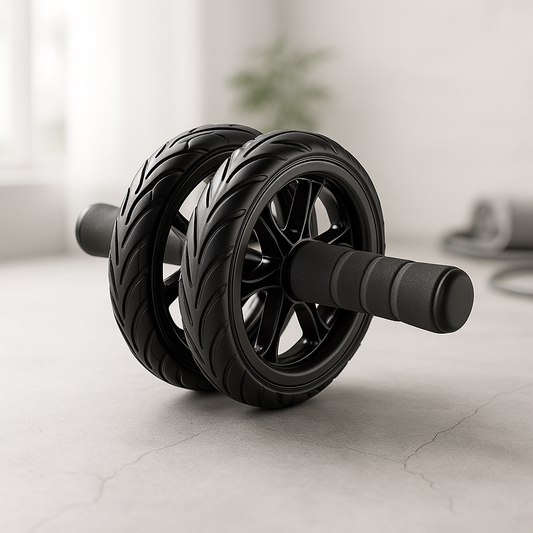
An ab roller is small, affordable, and far tougher than it looks. It trains your abs to resist spinal extension while your shoulders and hips stay connected. That carries over to planks, push-ups, lifting, and athletic movement.
Start with short rollouts. Keep your ribs down and squeeze your glutes. If your lower back takes over, reduce the range immediately. A mat under your knees makes the movement more comfortable.
- Footprint dimensions: About 12 x 7 x 7 inches. No folded size.
- Weight capacity: Select a model rated for at least 300 pounds of user weight.
- Resistance type / motor horsepower: Bodyweight rolling resistance. Some models include return assistance.
- Noise level assessment: Low on a workout mat. Moderate on hard flooring due to wheel contact.
5. A Workout Mat for Comfort and Noise Control
A workout mat protects your joints, flooring, and neighbors. It creates a defined training zone, which helps make workouts easier to start. Use it for floor strength, yoga, mobility work, and recovery sessions.
Thickness depends on your training. A thinner mat feels more stable for standing work. A thicker mat protects knees and elbows better. For mixed home training, 6 millimeters is a practical middle ground.
- Footprint dimensions: About 72 x 24 x 0.24 inches unfolded. Roughly 24 x 6 x 6 inches when rolled.
- Weight capacity: Not usually manufacturer-rated. It should support your full bodyweight on a flat, stable surface without tearing.
- Resistance type / motor horsepower: None. Closed-cell foam or dense TPE cushioning.
- Noise level assessment: Very low. It reduces impact sound and equipment vibration on hard floors.
6. A Massage Ball for Recovery and Mobility
Training consistently requires recovery habits. A massage ball is compact enough to keep near your desk, couch, or gym bag. Use it on the feet, glutes, upper back, and chest muscles after long periods of sitting or training.
It will not replace medical care for injury, numbness, swelling, or sharp pain. It can help you maintain a simple mobility routine between workouts.
- Footprint dimensions: About 2.5 inches in diameter. No folded size.
- Weight capacity: Choose a dense rubber or cork ball rated to withstand at least 300 pounds of static body pressure.
- Resistance type / motor horsepower: None. Pressure-based self-massage.
- Noise level assessment: Very low on a mat or carpet. Low on hardwood if rolled slowly.
Do You Need Cardio Equipment?
Not always. Walking, stairs, low-impact bodyweight intervals, and shadowboxing can build cardio fitness without a machine. Buy a stationary bike only if weather, safety, or time makes outdoor movement unreliable.
For apartment living, a magnetic-resistance bike is usually more practical than a treadmill. It produces less impact noise and needs less maintenance.
- Footprint dimensions: Around 40 x 20 inches in use. Foldable models may store around 20 x 20 inches.
- Weight capacity: Choose at least a 275-pound user rating.
- Resistance type / motor horsepower: Manual magnetic resistance. No motor required.
- Noise level assessment: Low. Magnetic systems are generally suitable for apartments when placed on a thick mat.
How to Choose Your Home Workout Equipment
Use this checklist before you buy:
- Measure the clear floor area, ceiling height, and doorway width first.
- Match each tool to a movement you need: squat, push, pull, hinge, core, or recovery.
- Check user ratings, anchor ratings, and product instructions before loading equipment.
- Prioritize quiet tools if you train upstairs or near shared walls.
- Choose equipment that stores in under two minutes.
- Buy enough resistance for your next six to twelve months, not only your first week.
- Leave room in your budget for a mat and recovery tool.