How to Build a Beginner Home Gym in Small Spaces
Share
A good home gym does not need a spare room. It needs enough clear floor space to move safely. If you are learning how to build a beginner home gym, start with versatile gear. Choose tools that support several movements, store easily, and will not punish your downstairs neighbors.
Start With Your Space, Not Your Shopping Cart
Measure your available training area before buying anything. A clear 6-by-8-foot zone works for most beginner bodyweight, band, and core sessions. You also need ceiling clearance for standing presses and jumping movements. Low ceilings are not a deal-breaker. They simply change your exercise choices.
Apartment training needs another check. Test your floor's feel and noise transfer. Concrete, tile, and hardwood amplify impact. Use controlled reps instead of jumps. Skip dropping weights completely. A quiet setup makes consistency easier.
Choose one training goal for your first eight weeks. Strength, mobility, general fitness, or core control are all valid. Trying to build a bodybuilding gym, yoga studio, and boxing room at once wastes space and budget.
Build Your Beginner Home Gym Around Four Tools
These four tools cover pulling, pushing, squatting, hinging, core work, and mobility. Check every product listing against these specifications. Manufacturer ratings always take priority over general guidelines.
1. Resistance Bands
Resistance bands create a full-body workout without a rack or heavy weights. They work well in compact rooms because they fit in a drawer. Use them for rows, presses, squats, deadlifts, lateral walks, and assisted pull-ups.
Look for a set with several resistance levels. Beginners need lighter options for pressing and shoulder work. They also need heavier options for rows and lower-body movements.
- Footprint dimensions: 12 x 6 x 2 inches stored; up to 48 x 1 x 0.2 inches unfolded per band
- Weight capacity: 300-pound maximum user or anchor rating
- Resistance type / motor horsepower: Layered latex or fabric elastic resistance; 10 to 50 pounds per band
- Noise level assessment: Very quiet; suitable for apartments and upstairs rooms
2. A Doorway Pull-Up Bar
A pull-up bar gives your home gym a vertical pulling option. That matters because rows alone may not challenge your upper back long-term. Beginners can use the bar for hangs, scapular pulls, band-assisted pull-ups, and controlled negatives.
Doorway bars are not universal. Measure the doorframe width and trim depth first. Avoid weak trim, damaged frames, and rental situations where installation marks could become a problem.
- Footprint dimensions: 24 x 6 x 3 inches stored; 24 to 40 x 6 x 3 inches installed
- Weight capacity: 300-pound minimum rated capacity
- Resistance type / motor horsepower: Bodyweight resistance; no motor
- Noise level assessment: Quiet during controlled reps; avoid swinging or kipping upstairs
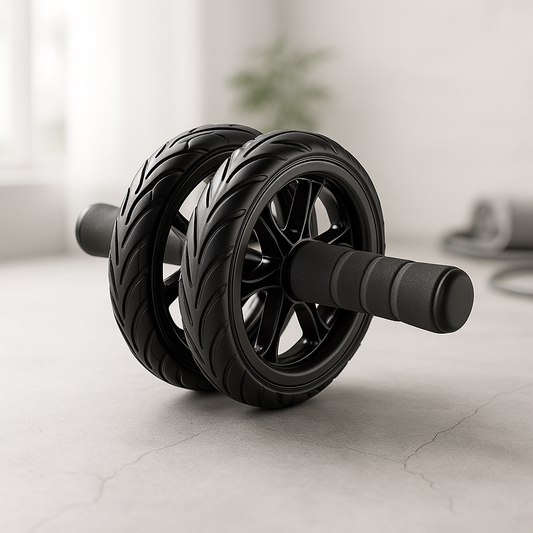
3. An Ab Roller
An ab roller looks simple. Used well, it builds serious trunk strength and shoulder control. It also takes almost no room. Start with short rollouts from your knees. Keep your ribs down and hips from sagging.
Do not rush toward full-range repetitions. A shorter, controlled rollout beats a long rep with an arched lower back. A padded surface helps protect your knees and keeps the wheel quieter.
- Footprint dimensions: 12 x 7 x 7 inches stored; 12 x 7 x 7 inches in use
- Weight capacity: 330-pound minimum rated capacity
- Resistance type / motor horsepower: Bodyweight resistance; no motor
- Noise level assessment: Low noise on a mat; moderate noise on bare hardwood or tile
4. A Non-Slip Exercise Mat
A mat is not just for stretching. It defines your training zone, reduces floor impact, and makes floor exercises more comfortable. It also gives you a visual cue to train. When the mat comes out, the session starts.
Choose enough length for your height. If you are tall, a short mat can make planks, mobility work, and floor presses frustrating. Thickness depends on the floor beneath you. Thicker is better for knees. Firmer is better for balance.
- Footprint dimensions: 72 x 24 x 0.25 inches rolled or stored; 72 x 24 x 0.25 inches unfolded
- Weight capacity: 300-pound user rating or higher
- Resistance type / motor horsepower: No resistance and no motor
- Noise level assessment: Very quiet; helps reduce contact noise in upstairs spaces
Set Up a Layout You Will Actually Use
Keep your mat in the center of the room. Store bands and the ab roller in a basket or drawer within arm's reach. Put the pull-up bar away after training if it blocks a doorway. The goal is fast setup, not a showroom.
Leave at least two feet of clearance around your working area. Watch for ceiling fans, low shelves, pets, and furniture corners. If your space is narrow, face the long direction when performing lunges or band presses.
For upstairs rooms, build intensity without impact. Slow squats, split squats, band rows, push-ups, and planks create plenty of challenge. You do not need burpees at 6 a.m. to make progress.
Follow a Simple Three-Day Training Plan
A beginner gym works when you use it repeatedly. Train three nonconsecutive days each week. Keep each session around 25 to 40 minutes. Start every exercise with two sets of eight to 12 controlled repetitions.
On day one, perform band squats, band rows, incline or knee push-ups, and short ab rollouts. On day two, use band deadlifts, overhead presses, assisted pull-up practice, and planks. On day three, repeat the first session or choose the movements that felt weakest.
Add difficulty slowly. Increase band resistance, repetitions, range of motion, or total sets. Change one variable at a time. This protects your joints and shows what is actually working.
Recovery belongs in the plan, too. Spend five minutes after each session on easy breathing, shoulder mobility, and hip stretches. Soreness is normal. Sharp pain, numbness, and joint instability are not training badges.
Avoid the Beginner Home Gym Traps
The biggest mistake is buying equipment before building a habit. A large machine may look motivating, but it can become an expensive clothes rack. Start small. Upgrade only after your routine proves what you need.
Do not buy gear based on maximum intensity alone. A heavy resistance level is useless if you cannot control it. Likewise, a pull-up bar is not a smart purchase if your doorway cannot support it safely.
Avoid storing everything out of sight. Convenience beats motivation on busy days. Your setup should take less than two minutes to prepare. That is where accessible equipment earns its place.
How to Choose Your Beginner Home Gym Equipment
Before checkout, use this practical checklist:
- Measure your open floor area, ceiling height, doorframe, and storage space.
- Confirm each item has a stated user, anchor, or weight rating.
- Choose quiet equipment if you share walls or live upstairs.
- Prioritize multiple movement options over single-exercise tools.
- Match resistance levels to your current strength, not future ambitions.
- Check that setup and storage take less than two minutes.
- Leave room in your budget for recovery and replacement items.