Recovery Tools Fitness Trends That Actually Help
Share
Hard workouts are only useful when you can repeat them. The biggest recovery tools fitness trends are moving away from complicated routines. They favor practical gear that reduces tightness, supports mobility, and fits between work, training, and sleep.
Recovery is not about avoiding effort. It is about preparing your body for the next session. The right tool can help you move better after strength training, running, cycling, or long hours at a desk. The wrong tool becomes clutter in a closet.
Recovery Tools Fitness Trends: What Is Worth Your Space?
The strongest trend is simple: people want targeted recovery tools. A single tool should solve a clear problem. Tight calves need pressure and movement. Stiff upper backs need mobility work. Sore feet may need precise release. Aching knees may need support during lower-impact movement.
Home and hybrid exercisers also care about noise. Apartment living changes what works. You may train before others wake up. You may recover late at night. Quiet, compact gear is often more useful than a large machine with impressive features.
Another change is the focus on consistency over intensity. A five-minute mobility session after training often beats one long recovery session every Sunday. The goal is a routine you will actually maintain.
Foam Rollers Still Earn Their Place
Foam rollers are not new, but they remain useful. They work well for broad muscle groups, including quads, glutes, hamstrings, calves, and the upper back. Use slow passes. Pause briefly on tender areas. Do not rush or force painful pressure.
A medium-density roller suits most home users. Extra-firm rollers can feel effective, but they may be too aggressive for beginners or sensitive muscles. A textured surface adds targeted pressure. It also adds intensity.
Use these practical benchmark specifications when comparing a standard full-length roller:
- Footprint dimensions: 13 x 5.5 inches unfolded; 13 x 5.5 inches when stored. It does not fold.
- Weight capacity: 300 pounds for supported bodyweight rolling.
- Resistance type / motor horsepower: Bodyweight pressure; no motor.
- Noise level assessment: Very quiet. Expect soft floor contact, not machine noise.
Massage Balls Are Small-Space Specialists
A massage ball takes almost no room. That makes it one of the best recovery tools for apartments, travel bags, and desk drawers. It gives you more precise pressure than a foam roller.
Use a massage ball under your foot after walking or running. Lean it against a wall for shoulders, chest muscles, and upper-back tightness. Start with a wall before moving to the floor. You can control the pressure better.
These compact specifications make a massage ball easy to store:
- Footprint dimensions: 2.5 x 2.5 inches unfolded; 2.5 x 2.5 inches when stored. It does not fold.
- Weight capacity: Not load-bearing as a platform. It is designed for controlled bodyweight pressure.
- Resistance type / motor horsepower: Firm rubber or cork compression; no motor.
- Noise level assessment: Nearly silent on a mat. Low noise on hard floors.
Percussion Massagers Need a Smarter Approach
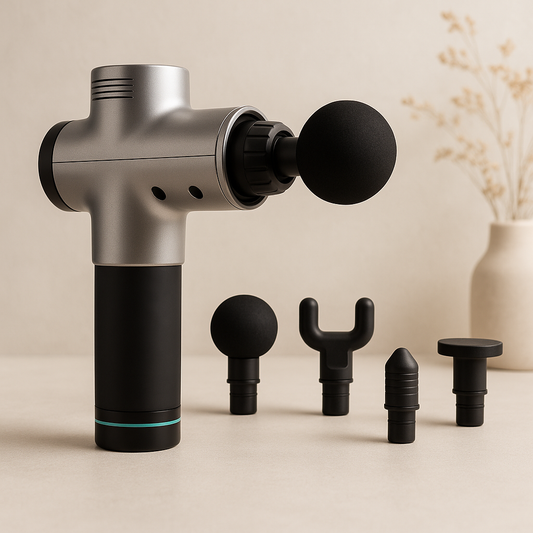
Percussion massagers are a major fitness recovery trend because they are fast. They can help you warm up a muscle group before training or relax it afterward. They are especially convenient for calves, quads, hamstrings, glutes, and upper traps.
They are not a replacement for sleep, hydration, nutrition, or sensible training volume. Think of them as a helpful add-on. Use light pressure for short intervals. Let the device do the work instead of pressing hard.
Compare compact percussion massagers against clear performance benchmarks:
- Footprint dimensions: 9 x 7 x 3 inches unfolded; 9 x 7 x 3 inches when stored. It does not fold.
- Weight capacity: Not applicable. It is a handheld device, not load-bearing equipment.
- Resistance type / motor horsepower: Brushless motor, approximately 0.04 horsepower or 30 watts.
- Noise level assessment: Moderate. A quiet model should stay near conversation-level sound on low settings.
Neck and Shoulder Massagers Fit Desk-Heavy Days
Recovery is not only for athletes. Desk posture, driving, and daily stress can leave the neck and shoulders feeling tight. A neck and shoulder massager offers convenient, hands-free pressure while you sit and reset.
Choose intensity carefully. Neck tissue can be sensitive. A heated feature may feel relaxing, but heat is optional. It should never be painfully hot. Use it for short sessions, then stand up and move your shoulders through a comfortable range.
For a compact, home-friendly neck and shoulder massager, use these specifications as a comparison point:
- Footprint dimensions: 15 x 7 x 6 inches unfolded; 15 x 7 x 6 inches when stored. It does not fold.
- Weight capacity: Not applicable. The device rests on the shoulders.
- Resistance type / motor horsepower: Electric kneading nodes with a low-power motor, approximately 0.03 horsepower or 20 watts.
- Noise level assessment: Low to moderate. Expect a soft mechanical hum, suitable for most living spaces.
Mobility Is Becoming Part of Recovery
The best recovery routine is active. That does not mean another exhausting workout. It means gentle movement that restores comfortable range of motion.
After a lower-body session, try a few minutes of ankle circles, hip rotations, and slow bodyweight squats. After upper-body training, use shoulder circles, wall slides, and thoracic rotations. Pair these movements with a roller or massage ball when needed.
This approach is more useful than chasing soreness. Soreness does not prove progress. Better movement, stable training habits, and gradual strength gains are stronger signs.
Build a Recovery Routine You Can Repeat
Keep the routine short. Start with five to 10 minutes after training. Use a foam roller for broad areas, a massage ball for a stubborn spot, or a percussion device when time is tight. Follow with easy mobility work.
Your timing depends on your goal. Before training, use lighter pressure and dynamic movement. You want to feel prepared, not relaxed or drained. After training, use slower pressure and comfortable stretches. On rest days, take a walk and address areas that feel restricted.
Do not use recovery tools to push through an injury. They can support normal training stiffness. They cannot fix poor technique, rapid workload increases, or ignored pain signals.
How to Choose Recovery Tools That Fit Real Life
Use this checklist before adding any recovery tool to your setup:
- Choose the body area you need to address most often.
- Measure your storage space before buying larger devices.
- Consider noise if you live upstairs or share walls.
- Start with moderate pressure, especially if you are new.
- Check whether the tool works on a mat or hard flooring.
- Favor tools you can use in five minutes.
- Avoid products that promise to treat injuries or replace care.