Ab Roller Review for Beginners That Builds Control
Share
An ab roller can humble a strong beginner fast. The issue is not motivation. It is control. This ab roller review for beginners focuses on the features that help you train safely, progress steadily, and avoid turning every rollout into a lower-back workout.
What a Beginner Ab Roller Should Actually Do
An ab roller looks simple because it is simple. You grip the handles, roll forward, then pull yourself back. But the movement demands far more than visible abs. Your shoulders, lats, hip flexors, glutes, and deep core must work together.
That is why the best beginner option is not always the smallest wheel. A stable wheel lets you learn bracing first. You should feel your abs resisting extension. You should not feel your lower back sagging toward the floor.
A good roller also earns its place in a small home setup. It stores easily, needs no outlet, and creates almost no noise when used correctly. Add a thick exercise mat or folded towel under your knees. Your joints will thank you.
Beginner Specification Benchmark
Ab rollers do not have a universal size or load rating. Always check the exact product listing before training. For a dependable beginner-friendly model, use these specifications as your benchmark:
- Footprint dimensions: 13.0 x 7.5 x 7.5 inches unfolded; folded footprint not applicable for a fixed-wheel roller
- Weight capacity: 300 pounds minimum, including a clear manufacturer rating
- Resistance type / motor horsepower: Bodyweight resistance; no motor or horsepower rating
- Noise level assessment: Low on a textured exercise mat; moderate on bare hardwood or tile due to wheel contact
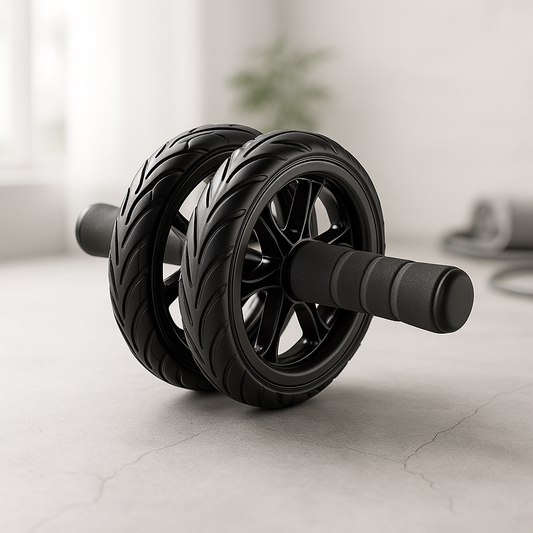
- Wheel design: 7.5-inch diameter wheel with a 3.0-inch-wide tread, or two closely spaced wheels
- Handle design: Non-slip foam or rubber handles with a steel axle
The Wheel Matters More Than Fancy Extras
A narrow, single-wheel roller offers a greater balance challenge. That can be useful later. For many beginners, though, it creates unnecessary instability. You spend the set fighting the wheel instead of learning the movement.
A wider single wheel or dual-wheel design is usually the better starting point. It tracks straighter. It gives you more confidence at the furthest point of each rollout. That confidence helps you keep your ribs down and glutes engaged.
Some rollers include automatic rebound assistance. The internal spring can help pull the wheel back. This may make early repetitions feel easier. It can also hide weak control if you rely on the spring every rep.
Choose rebound assistance if returning from a knee issue, training with low confidence, or building a basic routine. Choose a standard wheel if you want the clearest feedback from your core. Neither choice replaces sound form.
Avoid ultra-cheap plastic wheels with smooth treads. They can slide on hard floors. They may also become loud in an upstairs apartment. A textured rubber or thermoplastic tread grips better and protects flooring.
What the Movement Trains
The ab roller is not only an ab exercise. It trains anti-extension strength. That means resisting the urge to arch your spine while your arms move away from your body.
This carries over to planks, push-ups, pull-ups, loaded carries, and overhead pressing. Better bracing can also make everyday lifting feel more controlled. Think grocery bags, moving boxes, or picking up a child from the floor.
The trade-off is intensity. A rollout becomes challenging quickly because your body acts like a long lever. Extending only a few inches can be enough for a new user. There is no prize for reaching farther before you can control the return.
If your goal is visible abdominal definition, understand the limit. An ab roller can build stronger abdominal muscles. It cannot decide where your body loses fat. Pair it with regular full-body training, daily movement, and nutrition habits you can maintain.
Form That Protects Your Lower Back
Start from your knees. Place the roller under your shoulders, not far in front of them. Use a mat under your knees. Set up with your toes lightly touching the floor for added balance.
Before rolling, squeeze your glutes. Exhale gently and bring your ribs down. Imagine tightening your midsection before someone taps your stomach. This brace should stay present through the full rep.
Roll forward slowly. Your hips and shoulders should travel together. Stop before your lower back arches or your shoulders feel pinched. Then press your hands into the handles and pull the roller back using your abs and lats.
Keep the range short at first. A strong four-inch rollout beats a sloppy full extension. Most beginners should begin with two sets of five to eight controlled repetitions, two times each week.
Rest at least 60 seconds between sets. Your core may recover quickly, but your shoulders and wrists still need attention. Stop the set when form changes. Fatigue is useful. Repeated spinal extension is not.
Common Errors and Quick Fixes
The most common mistake is letting the hips drop. This shifts stress into the lower back. Fix it by shortening the range, squeezing your glutes harder, and rolling out more slowly.
Another mistake is pulling back with bent elbows. Your elbows can stay soft, but they should not turn the movement into a triceps exercise. Keep your arms long and pull from your lats and core.
Many people also hold their breath. A brief exhale during the rollout can help maintain a strong rib position. Then breathe in as you return. Stay controlled rather than forcing a dramatic breath pattern.
If your wrists hurt, check handle thickness and wrist position. Keep your knuckles pointed forward. Do not let your hands collapse inward. A neutral-grip handle with textured padding can make a meaningful difference.
A Realistic Four-Week Starting Plan
In week one, practice kneeling rollouts to a very short range. Complete two sets of five reps. Finish each session feeling like you could perform two more clean reps.
In week two, move to three sets of five or six reps. Pause for one second at your furthest controlled point. The pause exposes weak bracing and teaches patience.
In week three, keep three sets but add distance gradually. Mark your starting point with tape if needed. Roll only one or two inches farther than before. Consistent range increases beat random max-effort attempts.
In week four, perform three sets of eight reps at your best clean range. If your back remains neutral and the return feels smooth, you can add one weekly session. If form slips, keep the same volume another week.
This pace may feel conservative. It works because connective tissue and shoulder stability need time to adapt. Train smarter. Build the strength that lets you keep training.
When an Ab Roller Is Not the Best First Choice
An ab roller is compact, affordable, and effective. It is not ideal for every starting point. If kneeling causes pain, use a folded towel, a thicker pad, or choose standing core exercises until your knees tolerate pressure.
If you have active shoulder pain, wrist pain, a recent abdominal surgery, or unresolved lower-back symptoms, get guidance from a qualified clinician before using one. Pain is different from normal muscular effort.
You may also need a different first exercise if you cannot hold a strong incline plank for 20 to 30 seconds. Build that base first. Wall planks, elevated planks, and dead bugs teach the same bracing skill with less leverage.
For a compact home gym, the ab roller still makes sense once you own the basics. It takes little space, fits a busy schedule, and can progress with you. Virfit-style home training works best when equipment removes excuses instead of creating clutter.
How to Choose an Ab Roller for Beginners
Use this checklist before you buy:
- Confirm a manufacturer-stated 300-pound minimum weight capacity.
- Choose a wide wheel or dual-wheel setup for better early stability.
- Look for textured rubber tread to reduce slipping and floor noise.
- Check for comfortable, non-slip handles and a steel axle.
- Measure 13 inches of storage length in your drawer or closet.
- Plan to use a knee pad, thick mat, or folded towel.
- Skip rebound assistance unless you need extra support returning.
- Avoid any model with unclear specifications or no load rating.