7 Best Ab Exercise Tools for Home Workouts
Share
A stronger core needs progressive tension, not endless crunches. The best ab exercise tools make that progression practical at home. Choose equipment that matches your space, current strength, and noise limits. A good tool should challenge your abs without turning every session into a lower-back or wrist problem.
What Makes the Best Ab Exercise Tools Worth Buying
Your abs transfer force between your upper and lower body. They also resist unwanted movement. That means effective training includes anti-extension, anti-rotation, flexion, and hanging knee-raise patterns.
Start with one or two tools. Learn control first. Add difficulty only when you can keep your ribs down, pelvis steady, and breathing controlled. The specifications below are practical minimum buying targets. Confirm the listed dimensions and ratings before ordering any specific model.
1. Ab Roller: Best for Progressive Core Strength
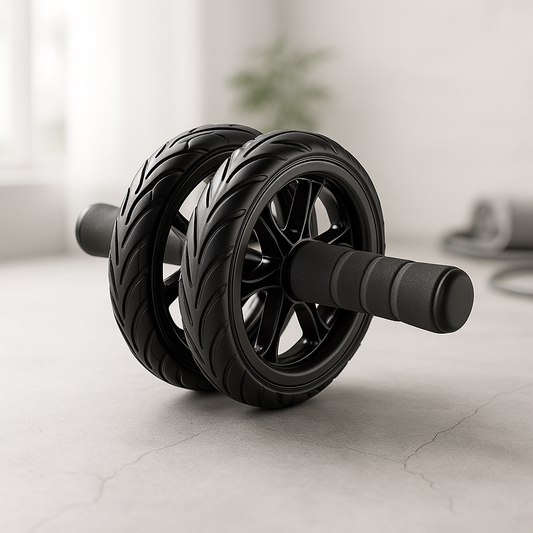
An ab roller is small, affordable, and brutally effective. It trains your abs to resist spinal extension as you roll forward. The long rollout is the goal, not the speed.
Beginners should roll from their knees toward a wall. Advanced users can increase range, slow the lowering phase, or progress toward standing rollouts. Use a thick mat under your knees. Stop if your low back starts sagging.
- Footprint dimensions: 12 x 7 x 7 inches; non-folding design
- Weight capacity: At least 300 pounds
- Resistance type / motor horsepower: Bodyweight resistance; no motor
- Noise level assessment: Low. The wheel may rumble on hard floors. Use a mat for apartments.
2. Resistance Bands: Best for Small Spaces
Resistance bands build core strength without bulky equipment. They add load to kneeling crunches, Pallof presses, wood chops, and dead-bug variations. They also work well when floor space is limited.
Anchor bands only to a solid, purpose-built anchor point. Do not loop them around unstable furniture. A snapped band or loose anchor can cause a fast, painful recoil.
- Footprint dimensions: 48 x 0.8 x 0.2 inches per long loop; folds to about 6 x 4 x 2 inches
- Weight capacity: Not applicable; select bands rated for 15-50 pounds of resistance each
- Resistance type / motor horsepower: Elastic resistance; no motor
- Noise level assessment: Very low. Ideal for upstairs workouts and early sessions.
3. Doorway Pull-Up Bar: Best for Hanging Knee Raises
Hanging knee raises challenge the lower abs, hip flexors, grip, and shoulders. A doorway pull-up bar gives you an efficient station for this work. It can also support pull-ups, dead hangs, and scapular control drills.
Start with bent-knee raises. Avoid swinging. Pause at the top, then lower for three seconds. If your grip fails first, use shorter sets instead of throwing your legs upward.
- Footprint dimensions: Fits door frames 24-36 inches wide; approximately 38 x 8 x 6 inches installed; removes for storage
- Weight capacity: At least 300 pounds
- Resistance type / motor horsepower: Bodyweight resistance; no motor
- Noise level assessment: Moderate. Metal contact and swinging can disturb shared walls. Use protective pads and controlled reps.
4. Core Sliders: Best for Quiet Apartment Training
Core sliders create a longer lever without adding heavy equipment. Exercises like body saws, mountain climbers, and sliding pikes create intense anti-extension work. They also take almost no storage space.
Use the correct surface. Plastic sliders glide on carpet. Foam or fabric sliders work better on hardwood, tile, and laminate. A towel can substitute on smooth floors, but it will not move as predictably.
- Footprint dimensions: 7 x 7 x 0.3 inches each; stacks to 7 x 7 x 0.6 inches
- Weight capacity: At least 250 pounds per pair
- Resistance type / motor horsepower: Bodyweight and surface friction; no motor
- Noise level assessment: Very low. One of the best choices for upstairs living.
5. Stability Ball: Best for Beginners Building Control
A stability ball makes basic core training more demanding through instability. It works well for ball crunches, stir-the-pot planks, hamstring curls, and wall-supported exercises. It can help beginners learn bracing without immediately loading the spine.
It is not the most compact option. It also needs clear floor space. But its versatility makes it useful beyond abs, especially for mobility and posterior-chain training.
- Footprint dimensions: 25.5 inches in diameter when inflated; deflates to roughly 10 x 8 x 3 inches
- Weight capacity: At least 600 pounds static weight rating
- Resistance type / motor horsepower: Bodyweight instability; no motor
- Noise level assessment: Low. It is quiet, though rolling can create light floor vibration.
6. Adjustable Ab Bench: Best for Loaded Training
An adjustable ab bench supports decline sit-ups, weighted crunches, reverse crunches, and controlled leg raises. It gives you a stable platform and makes progression simple. Increase the angle, slow the tempo, or add a light plate.
This is a better choice for dedicated training spaces. It is less apartment-friendly than bands or sliders. It also requires good technique. Aggressive decline sit-ups can irritate some backs and hip flexors.
- Footprint dimensions: 50 x 20 x 20 inches unfolded; 50 x 20 x 8 inches folded
- Weight capacity: At least 500 pounds total user and load capacity
- Resistance type / motor horsepower: Adjustable decline angle and external weight; no motor
- Noise level assessment: Low to moderate. Quiet during use, but folding and moving can create impact noise.
7. Ab Wheel With Resistance Assist: Best for Building Toward Full Rollouts
An assisted ab wheel uses an internal spring or elastic mechanism to help you return from the extended position. It keeps the rollout pattern accessible for beginners. It can also help heavier users train with more confidence.
The trade-off is reduced challenge at the hardest part of the rep. Once you can control full kneeling rollouts, a standard wheel may offer better long-term progression.
- Footprint dimensions: 13 x 8 x 8 inches; non-folding design
- Weight capacity: At least 300 pounds
- Resistance type / motor horsepower: Internal spring assist; no motor
- Noise level assessment: Low. Slight wheel noise on bare floors. A mat keeps it quieter.
How to Choose Ab Exercise Tools for Your Home
Use this checklist before adding equipment to your setup:
- Measure your training area. A roller needs open floor length. A bench needs permanent clearance. Bands need a safe anchor point.
- Match the tool to your current level. Stability balls and assisted rollers help beginners. Pull-up bars and standard rollers demand stronger control.
- Consider your neighbors. Sliders and bands are quiet. Hanging work can create vibration. Place mats under rolling tools and benches.
- Check total weight ratings. Include your bodyweight, any added load, and the force created during movement.
- Prioritize progression. Buy tools that can grow with you through range, resistance, tempo, or exercise variations.
- Protect your joints. Use knee padding for rollouts. Avoid aggressive ranges that create back, shoulder, or wrist pain.