7 Best Beginner Strength Training Tools
Share
Starting strength training usually fails for one reason. People buy gear that is too advanced, too bulky, or too easy to ignore. The best beginner strength training tools fix that fast. They should be simple to learn, useful in small spaces, and versatile enough to keep delivering results after week one.
What makes the best beginner strength training tools?
Beginners need tools that teach movement, not just add resistance. That means stable equipment, simple setup, and enough exercise variety to build a real routine. If you live in an apartment, noise matters too. If you train in a bedroom or office corner, footprint matters just as much.
The best setup is usually not a full rack or a bench. It is a small group of tools that covers pushing, pulling, squatting, hinging, carrying, and core work. That gives you room to improve without turning your home into a crowded gym.
1. Loop resistance bands
Resistance bands are one of the smartest first buys. They are easy on joints, easy to store, and useful for nearly every major muscle group. For beginners, they also teach control. That matters more than chasing heavy weight too soon.
Bands work especially well if you are rebuilding fitness, managing soreness, or training in a tight space. They are not perfect for max strength later on, but they are excellent for learning form and building consistency.
- Footprint Dimensions: Folded about 8 x 4 x 2 inches; unfolded length typically 12-41 inches depending on style
- Weight Capacity: Not rated like metal equipment; effective resistance commonly ranges from 5-125 pounds across a full set
- Resistance Type / Motor Horsepower: Elastic resistance
- Noise Level Assessment: Very quiet; ideal for apartments and upstairs use
2. Adjustable dumbbells
If you want one tool that grows with you, this is it. Adjustable dumbbells give you a wide exercise menu without taking over the room. Presses, rows, squats, deadlifts, carries, curls, and split squats are all on the table.
They do cost more upfront than bands. But they often replace an entire dumbbell rack. For beginners who want clear strength progress, that trade-off makes sense.
- Footprint Dimensions: Folded/stored footprint usually 14-17 x 7-9 inches per dumbbell with tray; unfolded not applicable
- Weight Capacity: Common range is 5-52.5 pounds per dumbbell, with some sets going higher
- Resistance Type / Motor Horsepower: Plate-loaded or dial-adjusted free weight resistance
- Noise Level Assessment: Low to moderate; quiet during controlled lifting, louder if dropped
When adjustable dumbbells make the most sense
Choose these if you want long-term value and clear progression. Skip them if your budget is tight and you are still building the habit. Bands may be the better first step in that case.
3. Doorway pull-up bar
A pull-up bar sounds advanced, but a doorway version is still beginner-friendly if you use it for more than pull-ups. You can hang for grip work, do assisted pull-ups with bands, train knee raises, and use it as an anchor point for other accessories.
For small homes, it is one of the best strength tools per square inch. Just make sure your doorway is compatible and your frame is sturdy.
- Footprint Dimensions: Stored around 36-40 x 10-12 x 2-4 inches; installed footprint depends on doorway width
- Weight Capacity: Commonly 220-300 pounds
- Resistance Type / Motor Horsepower: Bodyweight resistance
- Noise Level Assessment: Low; may create minor frame creaking if installed loosely
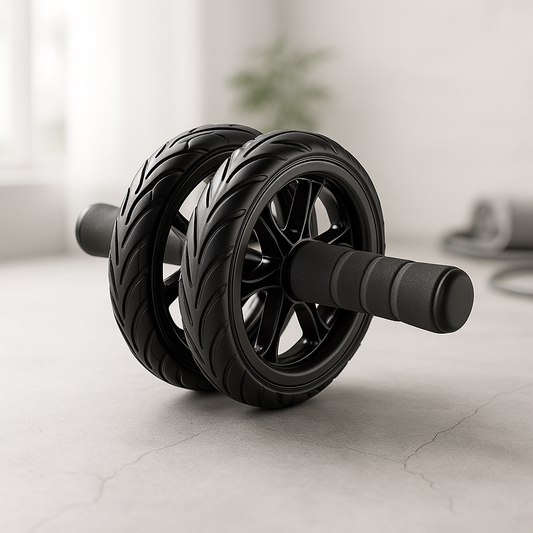
4. Ab roller
This tool looks simple because it is simple. That is part of the appeal. An ab roller trains more than abs. It challenges the shoulders, lats, and trunk stability at the same time. For beginners, short-range rollouts are enough.
The catch is progression. If your core is very deconditioned, full rollouts can feel brutal. Start from the knees and keep the range small. Good form beats long reps every time.
- Footprint Dimensions: Folded about 12-14 x 6-8 x 6-8 inches; unfolded about the same
- Weight Capacity: Commonly 220-300 pounds depending on axle build
- Resistance Type / Motor Horsepower: Bodyweight and lever-based resistance
- Noise Level Assessment: Very quiet on a mat; moderate on hard floors
5. Kettlebell
A kettlebell is one of the most efficient tools for total-body strength. Goblet squats, deadlifts, presses, rows, carries, and swings all build useful strength fast. It also teaches coordination and grip in a way machines cannot.
For beginners, one moderate kettlebell can go a long way. The main trade-off is exercise skill. Swings and cleans need coaching or careful practice. If you want the simplest learning curve, dumbbells are easier.
- Footprint Dimensions: Stored footprint usually 7-10 x 7-10 inches; unfolded not applicable
- Weight Capacity: Single fixed weight, commonly 10-35 pounds for beginners
- Resistance Type / Motor Horsepower: Fixed free weight resistance
- Noise Level Assessment: Low when controlled; high if set down hard on upper floors
6. Suspension trainer
This is one of the most overlooked beginner tools. A suspension trainer lets you change difficulty by adjusting body angle. That means rows, presses, squats, lunges, curls, and core work can all scale with your strength.
It is especially useful if floor space is limited. You anchor it to a door or sturdy point, train, then pack it away. For people who get bored easily, the variety helps a lot.
- Footprint Dimensions: Folded about 8 x 6 x 3 inches; unfolded strap length often 6-8 feet
- Weight Capacity: Commonly 300-700 pounds depending on anchor system
- Resistance Type / Motor Horsepower: Bodyweight suspension resistance
- Noise Level Assessment: Very quiet; light door contact noise possible
7. Mini bands
Mini bands are not your main strength tool. They are your support tool. They help with glute activation, shoulder prep, warm-ups, and lower-body control. That sounds small, but it matters. Better movement quality usually means better strength sessions.
They are also cheap, portable, and easy to add to recovery days. If you sit a lot or deal with cranky hips and knees, mini bands earn their place quickly.
- Footprint Dimensions: Folded about 4 x 4 x 1 inches; unfolded loop diameter varies by tension level
- Weight Capacity: Effective resistance usually 5-30 pounds depending on band thickness
- Resistance Type / Motor Horsepower: Elastic loop resistance
- Noise Level Assessment: Silent; excellent for shared spaces
Best beginner strength training tools by situation
If you have very little space, start with loop bands, mini bands, and a suspension trainer. That setup stores in a drawer and still covers most movement patterns.
If you want the fastest path to traditional strength progress, adjustable dumbbells are the best anchor tool. Add a pull-up bar later for upper-body balance.
If you need apartment-friendly gear, prioritize bands, suspension training, and an ab roller on a mat. Kettlebells and dumbbells work too, but only if you control every rep and every set-down.
If your budget is tight, begin with loop bands and mini bands. That pairing costs less, travels easily, and removes the excuse that you need a full home gym to start.
How to choose the right setup
Use this checklist before you buy anything.
- Pick tools that match your space. Measure the floor area first.
- Check noise tolerance if you live upstairs or share walls.
- Prioritize versatility over novelty. More exercises beats more gadgets.
- Make sure resistance can progress with you for at least 3-6 months.
- Choose gear you can set up in under two minutes.
- If form is a concern, start with simpler tools like bands or dumbbells.
- If recovery is part of your goal, add mobility or support accessories later.
A smart beginner setup usually starts with two categories. One primary strength tool, such as adjustable dumbbells or bands. One support tool, such as mini bands, a pull-up bar, or an ab roller. That is enough to build a real routine without wasting money.
Virfit’s approach fits that reality well. Train smarter. Recover better. Stay consistent.
The best gear is the gear you will use next Tuesday, not just the gear that looks impressive today. Start small, train with intent, and let consistency do the heavy lifting.