7 Core Training Equipment for Home Workouts
Share
A stronger core does not require a bulky bench or loud machines. The right core training equipment for home can fit beside a couch, under a bed, or inside a closet. Start with tools that match your space, protect your floors, and make short workouts worth repeating.
Build a Home Core Setup That Gets Used
Your core does more than shape your midsection. It helps you brace during squats, stabilize during push-ups, and move better through daily life. That makes consistency more valuable than a complicated routine.
For most homes, a smart setup includes one rolling tool, one resistance tool, one hanging or bracing option, and one floor-based accessory. You do not need all of it on day one. Begin with the tool that removes your biggest training barrier.
Apartment dwellers should prioritize quiet contact points. Look for padded wheels, fabric bands, foam grips, and non-slip surfaces. If you train upstairs, avoid equipment that drops, slides loudly, or requires jumping.
The specifications below are practical targets to shop against. Always confirm the listed measurements and mounting requirements before buying.
1. Ab Roller: High-Return Core Training Equipment for Home
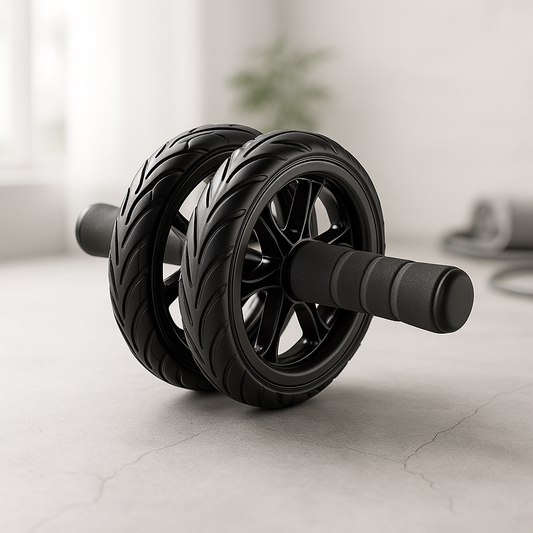
An ab roller creates serious demand with almost no footprint. It trains anti-extension strength, meaning your abs resist the lower-back arch that often appears during planks and push-ups. It also challenges shoulders, lats, and hip control.
Beginners should use short rollouts. Start from your knees and roll only as far as you can return without losing a neutral spine. Advanced users can increase range, slow the lowering phase, or progress toward standing rollouts.
Recommended physical specifications:
- Footprint dimensions: 12 x 7 inches unfolded; 12 x 7 x 7 inches stored. It does not fold.
- Weight capacity: 440 pounds minimum.
- Resistance type: Bodyweight resistance through a 7-inch to 8-inch textured wheel.
- Noise level assessment: Low on a thick exercise mat; moderate on hardwood or tile.
2. Resistance Bands: Train Rotation, Bracing, and Control
Resistance bands are the most flexible core tool for small homes. They let you train anti-rotation presses, wood chops, dead bugs, Pallof presses, and resisted marches. Those movements build the bracing strength that carries over to lifting, running, and daily movement.
Bands also solve a common problem with bodyweight core work: progression. You can add tension without buying a heavier machine or adding more floor space.
Recommended physical specifications:
- Footprint dimensions: 48 x 2 inches unfolded for a loop band; 6 x 4 x 2 inches when coiled for storage.
- Weight capacity: 300 pounds for the door anchor; 150 pounds maximum combined band tension.
- Resistance type: Layered latex or fabric elastic resistance, ideally 15 to 50 pounds per band.
- Noise level assessment: Very low. Bands are among the best choices for apartments and early workouts.
Fabric hip bands can also support core work. Use them for lateral walks and glute bridges. Stronger hips make it easier to control pelvic position during planks and rollouts.
3. Pull-Up Bar: Build a Stronger Hanging Core
A pull-up bar is not only for back training. Hanging knee raises, leg raises, and controlled dead hangs challenge your abs while improving grip and shoulder strength. It is a powerful option for intermediates who have outgrown basic crunches.
The trade-off is installation and ceiling clearance. Doorway bars need a solid frame. They also need enough room for your head, shoulders, and bent knees. If your doorway is low, use tucked knee raises instead of straight-leg raises.
Recommended physical specifications:
- Footprint dimensions: 37 x 10 x 8 inches installed; 37 x 10 x 8 inches stored. Most doorway bars do not fold.
- Weight capacity: 300 pounds minimum.
- Resistance type: Bodyweight resistance with a leverage-mounted or telescoping doorway design.
- Noise level assessment: Low during controlled reps; moderate if the bar shifts or feet hit the wall.
If you rent, inspect the door frame and use protective pads. A damaged frame costs more than a gym membership.
4. Core Sliders: Quiet Strength for Tight Spaces
Core sliders look simple, but they make planks far more demanding. You can slide the hands forward, pull knees toward the chest, or move one leg at a time. The surface creates instability without the impact of jumping exercises.
They are especially useful when you need a quiet workout before work or after bedtime. Sliders also work well in a short circuit with an ab roller and resistance band.
Recommended physical specifications:
- Footprint dimensions: 7 x 7 inches per slider unfolded; 7 x 7 x 0.4 inches stacked for storage.
- Weight capacity: 220 pounds per slider.
- Resistance type: Low-friction sliding resistance from dual-sided foam and plastic surfaces.
- Noise level assessment: Very low on carpet; low on hardwood when used with controlled pressure.
5. Exercise Mat: The Base Layer That Protects Your Training
A quality mat is not optional if you train on hard floors. It improves grip, cushions knees, reduces ab roller noise, and helps protect flooring. It also gives your workout a defined space, which makes it easier to start.
For core training, thin yoga mats can feel too harsh during kneeling work. A thicker mat is usually better for rollouts, planks, and dead bugs. However, very soft mats can make balance work less stable.
Recommended physical specifications:
- Footprint dimensions: 72 x 24 inches unfolded; 24 x 6 x 6 inches rolled for storage.
- Weight capacity: 350 pounds minimum for regular bodyweight floor training.
- Resistance type: None. Choose 6 mm high-density TPE or NBR foam cushioning.
- Noise level assessment: Very low. It reduces vibration and rolling noise on hard floors.
A Simple 15-Minute Core Session
Use your equipment to create a repeatable routine, not an exhausting one-off workout. Train two or three times weekly. Keep one rest day between hard ab roller sessions.
Start with band Pallof presses for 10 repetitions per side. Follow with eight to 12 slider knee tucks. Then perform six to 10 kneeling ab rollouts. Finish with five to 10 hanging knee raises or a 20-second dead hang.
Complete two or three rounds. Rest for 45 to 60 seconds between rounds. Stop each set before your lower back takes over. Clean reps beat high rep counts.
How to Choose Core Training Equipment for Home
Before you buy, use this checklist:
- Measure your available floor space, doorway width, and ceiling clearance.
- Match equipment capacity to your bodyweight plus a safety margin.
- Choose low-noise tools if you share walls, floors, or schedules.
- Prioritize one tool you will use three times weekly.
- Select equipment with grippy contact points and durable materials.
- Build progression into your setup through range, tension, or tempo.
- Keep recovery in the plan with mobility work and rest days.