Neck Massager Review for Desk Workers
Share
By 3 p.m., your shoulders creep upward, your neck gets stiff, and your focus drops fast. That is exactly why this neck massager review for desk workers matters. The right device can reduce daily tension, support recovery, and help you stay consistent at work and in training. The wrong one ends up in a drawer after a week.
What desk workers actually need from a neck massager
Desk tension is not the same as post-workout soreness. It builds slowly. It usually sits at the base of the skull, across the upper traps, and between the shoulder blades. That changes what matters in a massager.
For office use, you want targeted pressure without needing a second person to position the device. You also want enough intensity to loosen tight tissue, but not so much force that you feel beat up before your next meeting. Heat helps, especially if your stiffness comes from long static posture. Noise matters too. If it sounds like a blender, it is not desk-friendly.
A good neck massager for desk workers should feel easy to use in short sessions. Ten to fifteen minutes is the sweet spot for most people. Longer is not always better. If the pressure is too aggressive, your neck can feel more irritated afterward.
Neck massager review for desk workers: the key product types
There is no single best style for everyone. It depends on how you carry tension, where you use it, and how much control you want.
Shiatsu wrap-style neck massagers
This is the most common format. It sits around the neck and shoulders, usually with rotating nodes and optional heat. Many include arm loops so you can pull downward and increase pressure.
This style works well for desk workers because it covers a broad area. You can hit the neck, upper traps, and sometimes the shoulder blades. It also gives you more control than a fixed pillow design.
The trade-off is bulk. These units are not subtle. They are better for home office breaks than for open-plan workplaces.
Typical technical specifications
- Footprint dimensions, unfolded: 15-20 in wide x 6-8 in deep x 7-10 in high
- Footprint dimensions, folded: 12-16 in wide x 6-8 in deep x 4-6 in high
- Weight capacity: Not user-weight rated, designed for seated upper-body use only
- Resistance type / motor horsepower: Electric rotary motor, typically 20-30W
- Noise level assessment: Low to moderate, usually acceptable for home offices
In practice, this is the strongest all-around option. If your pain pattern moves between neck and shoulders, start here.
Pillow-style neck massagers
These are compact cushions with internal massage nodes. You place them behind the neck, upper back, or lower back. They are easy to move between chairs and couches.
The biggest advantage is versatility. A pillow unit can support more than one area, which gives it better value if you also deal with mid-back tension from sitting. The downside is fit. On the neck, placement can be awkward. If the nodes do not line up with your body, the massage feels random instead of precise.
Typical technical specifications
- Footprint dimensions, unfolded: 12-14 in wide x 4-6 in deep x 8-10 in high
- Footprint dimensions, folded: Same as unfolded, non-folding format
- Weight capacity: Not user-weight rated, intended for contact-pressure use only
- Resistance type / motor horsepower: Electric rotary motor, typically 18-25W
- Noise level assessment: Low, usually quieter than wrap-style units
This style is best if you want one device for several body areas. It is less ideal if your main issue is the neck alone.
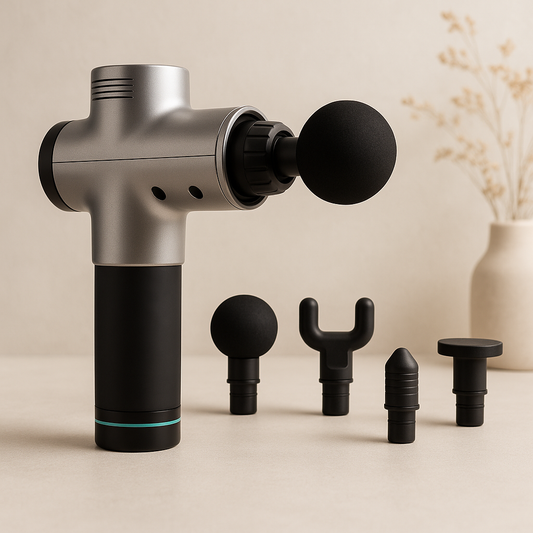
Percussion handheld massagers
These use rapid tapping instead of kneading. They can be strong, fast, and useful for thicker muscle groups.
For desk workers, they are a mixed bag. They can help the upper traps, but the neck itself is sensitive. Too much percussion near the cervical spine can feel harsh. They also require active use, which is not great if you want passive recovery during a short break.
Typical technical specifications
- Footprint dimensions, unfolded: 14-18 in long x 3-5 in wide x 5-7 in high
- Footprint dimensions, folded: Usually non-folding
- Weight capacity: Not applicable, handheld format
- Resistance type / motor horsepower: Percussion motor, typically 20-40W
- Noise level assessment: Moderate to high, often too loud for shared workspaces
This is better for athletes who want all-purpose recovery. For pure desk tension, it is usually not the first pick.
Pulse or EMS-style neck massagers
These lightweight devices use electrical pulse stimulation instead of mechanical kneading. They often look sleek and portable.
They are quiet and easy to carry. That makes them attractive for commuting or office use. But intensity is highly individual. Some people find the sensation effective. Others find it odd or underwhelming. They also do less for thick shoulder tension.
Typical technical specifications
- Footprint dimensions, unfolded: 5-7 in wide x 4-6 in deep x 1-3 in high
- Footprint dimensions, folded: Same as unfolded
- Weight capacity: Not applicable, wearable format
- Resistance type / motor horsepower: EMS pulse system, battery-powered
- Noise level assessment: Very low to silent, excellent for office use
If you need something portable and discreet, this type has a place. If you want deep tissue feel, it probably will not satisfy you.
What separates a good neck massager from a disappointing one
Pressure control is the first divider. Desk workers rarely need maximum force all the time. The better units let you adjust intensity or manually change pressure with your arms. That makes the device more useful over time.
Heat is the second divider. Not blazing heat. Usable heat. Mild warmth can improve comfort and help tight muscles relax. Weak heat functions often feel like a feature added for the box, not for the body.
The third factor is node placement. This matters more than people expect. If the massage heads sit too high, they push into the wrong part of the neck. Too low, and they miss the area where most desk tension lives.
Build quality also matters. Cheap stitching, flimsy arm straps, and inconsistent motor speed usually show up fast. A massager should feel stable when you lean into it. If it shifts constantly, you will stop using it.
Best fit by work style
If you work from home, a wrap-style shiatsu unit is usually the smartest buy. It gives the most complete coverage and feels closest to hands-on pressure. It is not tiny, but home use removes most of the portability downside.
If you split time between office and home, a compact pillow or EMS device makes more sense. You lose some intensity, but you gain convenience. That matters if you want daily use instead of occasional use.
If you train hard after work, consider how the massager fits your recovery routine. A neck device should help you reset, not replace mobility work. If your chest is tight and your thoracic spine barely moves, massage alone will not fix the pattern.
A realistic neck massager review for desk workers
The best-performing option for most desk workers is still the wrap-style shiatsu massager with heat. It wins on coverage, controllable pressure, and overall effectiveness. It is the least elegant and the most useful. That is usually a good trade.
The best compact option is the pillow-style unit if you want one tool for neck and back use. Just expect a little trial and error with positioning.
The quietest option is the EMS style. It works best for light tension, travel, and low-profile office use. It is not the deepest treatment, but it is the easiest to use consistently.
The least desk-friendly option is the percussion handheld. It has value, but mostly for broader recovery needs. If your main goal is easing screen-time stiffness, it is harder to justify.
For a performance-minded recovery setup, this is the simple ranking:
- Best overall for desk workers: Wrap-style shiatsu with heat
- Best for portability: EMS wearable neck massager
- Best multi-use value: Pillow-style massager
- Best for athletes, not office recovery: Handheld percussion massager
How to choose the right one
Use this checklist before you buy:
- Choose wrap-style shiatsu if your tension sits in both neck and shoulders.
- Choose pillow-style if you also want upper and lower back use.
- Choose EMS if silence and portability matter most.
- Skip very aggressive percussion for direct neck work.
- Look for adjustable intensity, not just on and off.
- Prioritize usable heat over marketing claims.
- Check dimensions if you plan to store it in a drawer.
- Keep noise low if you work near other people.
- Pick a device you will use three times a week, not admire once.
Virfit’s recovery approach is simple. Train smarter. Recover better. For desk workers, that often starts with reducing the daily tension that steals energy before your workout even begins.
The best neck massager is not the one with the longest feature list. It is the one that fits your workday, your tolerance, and your recovery habits well enough to earn a permanent spot in your routine.