Upper Body Training Tools for Small Home Spaces
Share
A crowded room should not stop your next upper-body session. The right upper body training tools build strength without consuming your floor space or upsetting downstairs neighbors. Start with tools that match your ceiling height, wall strength, storage needs, and training goals.
Build a Small-Space Upper-Body Setup
You do not need a bench, cable machine, and dumbbell rack. A focused setup can train your chest, back, shoulders, arms, grip, and core.
Prioritize pulling, pushing, and controlled resistance. Then add conditioning or recovery when it serves your routine. Buy for the workouts you will repeat, not the workouts you might try once.
The specifications below are practical buying targets. Always confirm your chosen product's stated measurements, weight rating, and installation requirements before ordering.
Doorway Pull-Up Bar
A pull-up bar delivers the hardest movement to replace at home: vertical pulling. Pull-ups, chin-ups, hangs, and knee raises train your back, arms, grip, and core with one compact tool.
Doorway bars work best for renters and small rooms. They require a sound frame, proper placement, and careful setup. Never install one on damaged trim, weak drywall, or a nonstandard frame.
- Footprint dimensions: 29.5-36.5 inches wide when installed; roughly 37 x 8 x 2 inches when removed for storage
- Weight capacity: At least 300 pounds for controlled bodyweight training
- Resistance type / motor horsepower: Bodyweight resistance; no motor
- Noise level assessment: Low noise when controlled; moderate impact noise during kipping or jumping starts
Resistance Band Set With Handles
Resistance bands are the most flexible option for tight spaces. They can cover rows, presses, flyes, curls, triceps extensions, face pulls, and shoulder work.
Bands also solve a common home-training issue: limited loading options. You can increase tension by choosing a thicker band, using two bands, or moving farther from the anchor.
- Footprint dimensions: About 48 inches long when unfolded; approximately 8 x 5 x 2 inches when stored
- Weight capacity: Choose door anchors rated for at least 300 pounds of pull force
- Resistance type / motor horsepower: Layered elastic resistance; a useful set spans 10-150 pounds combined resistance
- Noise level assessment: Very low noise; ideal for apartments, early workouts, and shared walls
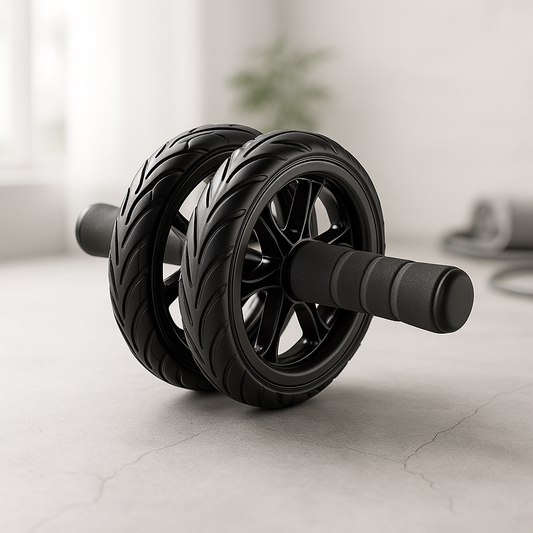
Ab Roller
The ab roller is not only for abs. Done correctly, it challenges your lats, shoulders, triceps, chest, and deep core. It teaches your upper body to stay strong while your torso resists extension.
This tool has a steep learning curve. Start from your knees. Roll only as far as you can control without arching your lower back.
- Footprint dimensions: Approximately 12 x 7 x 7 inches in use; about 12 x 7 x 7 inches for storage
- Weight capacity: At least 250 pounds
- Resistance type / motor horsepower: Bodyweight leverage resistance; no motor
- Noise level assessment: Low on a mat; moderate on hard flooring due to wheel vibration
Push-Up Handles
Push-up handles create clearance between your hands and the floor. That can make pressing more comfortable for wrists and allow a deeper range of motion.
They are especially useful if flat-palmed push-ups aggravate your wrists. They also pack away easily under a bed, couch, or desk.
- Footprint dimensions: Two handles need about 10 x 8 x 4 inches in use; roughly 10 x 8 x 4 inches when stored
- Weight capacity: At least 300 pounds combined
- Resistance type / motor horsepower: Bodyweight resistance; no motor
- Noise level assessment: Very low noise with non-slip bases; avoid sliding models on wood floors
Freestanding Punching Trainer
A punching trainer adds upper-body conditioning, shoulder endurance, coordination, and stress relief. It is a strong option if you get bored with sets and reps.
It also demands more space than bands or handles. Choose it only if you can leave a clear striking zone around the base. In an upstairs apartment, impact noise may outweigh the training benefit.
- Footprint dimensions: About 24 x 24 inches at the base; allow a 72 x 72-inch clear training area; typically not foldable
- Weight capacity: Base should hold at least 200 pounds when filled with water or sand
- Resistance type / motor horsepower: Spring-loaded rebound resistance; no motor
- Noise level assessment: Moderate to high impact noise; better for ground-floor rooms, garages, or insulated training areas
Match Tools to Your Main Goal
Your goal should decide the order of purchase. If you want stronger back and arms, buy a pull-up bar and bands first. If chest and triceps are the priority, start with handles and bands.
For complete upper-body development, combine push and pull patterns each week. Push-ups alone can build pressing strength, but they do not replace rows or pull-ups. Bands alone offer range and convenience, but they may not challenge advanced trainees without heavier tensions or smarter setup.
A simple three-day approach works well. On day one, perform pull-ups or band pulldowns, band rows, and curls. On day two, use push-up handles, band chest presses, and triceps extensions. On day three, pair light band shoulder work with ab rollouts and mobility.
Keep most sets controlled. Add reps before adding speed. Consistency beats an overly complicated routine.
Train Hard Without Creating Apartment Noise
Noise is a real equipment feature. It affects when you train and whether you keep training. Quiet gear gets used more often.
Resistance bands, push-up handles, and an ab roller on a mat are apartment-friendly choices. A doorway bar is also quiet when you avoid jumping and swinging. Punching trainers create the most vibration and impact noise.
Use a dense mat beneath your training zone. Set equipment down instead of dropping it. Choose slow tempos, especially during early mornings. These small adjustments protect floors, reduce noise, and improve control.
How to Choose Upper Body Training Tools
Use this checklist before you commit space and money:
- Measure your doorway width, ceiling height, and available floor area.
- Check whether your walls, doorframes, and floors support the intended setup.
- Choose a weight rating above your current bodyweight or expected training load.
- Match resistance to your current strength, then leave room to progress.
- Prioritize quiet equipment if you live upstairs or share walls.
- Select tools that store easily if your training area doubles as a bedroom or living room.
- Buy for your main movement gap: pull, push, core stability, or conditioning.
- Add recovery support if soreness limits your next session.