Muscle Recovery Tools Guide for Faster Relief
Share
Sore legs after squats. Tight shoulders after desk work. A stiff back after a rushed home workout. A good muscle recovery tools guide helps you fix the real problem - getting your body ready for the next session without wasting money on tools you will not use. The best option is usually the one that fits your space, pain points, and routine.
Muscle recovery tools guide: what actually works
Recovery tools do not build fitness on their own. They help you train again with less stiffness, better range of motion, and fewer excuses. That matters if you are balancing home workouts, gym sessions, work stress, and limited space.
The key is matching the tool to the kind of soreness you have. Broad muscle fatigue responds well to rollers and compression. Sharp knots usually need a ball or massage gun. Mobility limits often improve more with a strap and consistent stretching than with aggressive pressure.
That is the trade-off many people miss. More intensity is not always better. If a tool leaves you guarding the area or feeling bruised for days, it is too much for the moment.
Foam roller
A foam roller is still one of the most useful recovery tools for most people. It covers big areas fast. Quads, glutes, calves, upper back, and lats all respond well. It is simple, durable, and easy to use before or after training.
A medium-to-high density roller works best for general home use. Softer rollers feel better for beginners, but they often lose shape faster. Firmer rollers create more pressure, which helps active users who want a deeper pass.
Technical specifications
- Footprint Dimensions: Unfolded roughly 18-36 in. length x 6 in. diameter; folded not applicable
- Weight Capacity: User bodyweight supported during floor work, commonly suitable up to 300 lb+
- Resistance Type / Motor Horsepower: None; manual pressure tool
- Noise Level Assessment: Very quiet; apartment-friendly with minimal floor noise on a mat
The downside is precision. A roller is not great for small trigger points around the shoulder blade or hip. It also takes some body positioning, which can be awkward if you are very sore or new to mobility work.
Percussion massage gun
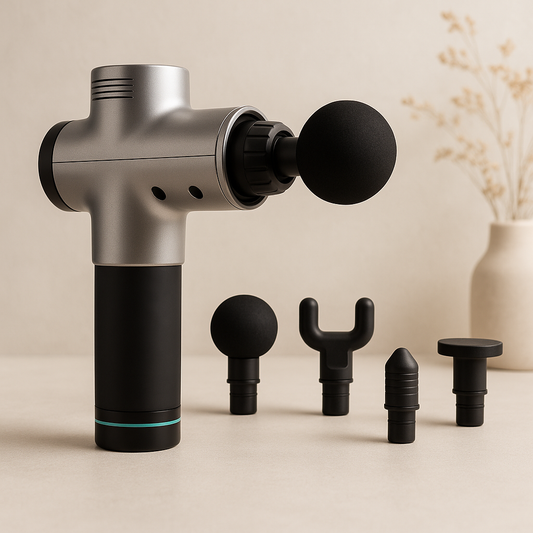
If you want speed and convenience, a massage gun earns its place. It is useful when you need targeted relief without getting on the floor. Calves, pecs, traps, glutes, and forearms are common problem areas. It can also work well for people who train hard but have limited time.
This tool makes sense if you value quick sessions. Two to five minutes per muscle group is often enough. Start with lower speed. Stay off joints and bony areas. More force does not mean better results.
Technical specifications
- Footprint Dimensions: Unfolded roughly 9 x 6 x 2.5 in.; folded not applicable; travel case often around 10 x 8 x 3.5 in.
- Weight Capacity: Not applicable; handheld device
- Resistance Type / Motor Horsepower: Electric percussion motor, commonly 20-60W
- Noise Level Assessment: Low to moderate; typically 40-60 dB, acceptable for apartments unless used late at night on high speed
The trade-off is cost and noise. A massage gun usually costs more than manual tools. It also does not replace mobility work. It reduces tension, but if your movement pattern is poor, tightness often returns.
Massage ball
For deep knots, a massage ball is hard to beat. It is small, cheap, and effective. Use it on the foot, glute, pec, rear shoulder, and around the hips. Against a wall, it gives you controlled pressure without needing much floor space.
This is one of the best tools for apartment living and small home setups. It stores in a drawer and works almost anywhere. For people who sit a lot, it is especially useful for chest and hip tension.
Technical specifications
- Footprint Dimensions: Unfolded roughly 2.5-3.5 in. diameter; folded not applicable
- Weight Capacity: User bodyweight supported against wall or floor, commonly suitable up to 300 lb+
- Resistance Type / Motor Horsepower: None; manual pressure tool
- Noise Level Assessment: Silent to very quiet; ideal for upstairs use when used against a wall or on a mat
The limitation is coverage. A ball works slowly on larger muscle groups. It can also be too intense for beginners. If you tense up while using it, reduce pressure or switch to a roller first.
Peanut massage ball
A peanut massage ball looks simple, but it fills a very specific role. It is excellent for the upper back and the muscles alongside the spine. Because the center gap avoids direct spinal pressure, it is more comfortable and safer than using a single ball on that area.
It is a smart pick if you feel stiff between the shoulder blades after lifting or sitting. It also works well for glutes and calves when you want more pressure than a roller can provide.
Technical specifications
- Footprint Dimensions: Unfolded roughly 5-6 in. length x 2.5-3 in. diameter; folded not applicable
- Weight Capacity: User bodyweight supported during floor work, commonly suitable up to 300 lb+
- Resistance Type / Motor Horsepower: None; manual pressure tool
- Noise Level Assessment: Very quiet; apartment-friendly on carpet or a yoga mat
The main drawback is versatility. It is more specialized than a standard ball. If you only want one manual recovery tool, a roller or single ball usually gives you more options.
Compression recovery boots
Compression boots are the premium option in this muscle recovery tools guide. They are best for runners, cyclists, leg-day regulars, and anyone dealing with heavy lower-body fatigue. The main benefit is passive recovery. You zip in, turn them on, and let the session run.
They can help reduce the heavy, beat-up feeling after intense training blocks. They are also easier to tolerate than aggressive massage for some users. If your legs are constantly loaded, that matters.
Technical specifications
- Footprint Dimensions: Unfolded roughly 28-38 in. leg sleeve length each; folded roughly 12 x 8 x 6 in. per set with controller
- Weight Capacity: Usually fits a broad user range; check calf and thigh circumference limits rather than bodyweight
- Resistance Type / Motor Horsepower: Electric air compression pump, commonly 12V controller system
- Noise Level Assessment: Low hum; typically 35-50 dB, suitable for apartments and shared spaces
The trade-off is obvious. They cost more and only target part of the body. If your budget is limited, manual tools offer better value across more muscle groups.
Stretch strap
A stretch strap is not flashy, but it solves a common problem. Many people have soreness that is partly a mobility issue. Tight hamstrings, calves, hips, and shoulders often improve with consistent assisted stretching, not just massage.
A strap helps you control position and hold stretches longer. That makes it useful for cooldowns, off days, and people returning from long periods of inactivity. It is also easy on joints compared with forcing range on your own.
Technical specifications
- Footprint Dimensions: Unfolded roughly 6-8 ft. length x 1 in. width; folded roughly 8 x 3 x 1 in.
- Weight Capacity: Tensile load varies by material, commonly 400-600 lb equivalent pull strength
- Resistance Type / Motor Horsepower: None; manual assisted stretch tool
- Noise Level Assessment: Silent; perfect for apartments and shared rooms
The limitation is that it requires consistency. A strap will not feel dramatic in one session. Used daily for five to ten minutes, it can make a clear difference.
How to build the right setup
Most people do not need every tool. They need a simple mix they will actually use. For a beginner, start with a foam roller and massage ball. That covers broad recovery and trigger-point work at a low cost. For a more advanced setup, add a massage gun for convenience or compression boots for high-volume leg training.
Space matters too. In a small apartment, quiet tools win. A ball, strap, and roller handle most needs without adding clutter. If upstairs noise is a concern, use them on a mat and avoid hard flooring when possible.
Your training style should decide the priority. Lifters often need glute, quad, lat, and pec work. Runners and cyclists benefit more from calves, hamstrings, hips, and compression-focused options. Desk workers usually need upper back, chest, neck-adjacent, and hip support.
How to choose recovery tools that fit real life
Use this checklist before you buy:
- Pick broad coverage first if you are building from zero
- Choose targeted tools if one area keeps tightening up
- Favor quiet equipment for apartments and shared spaces
- Buy for frequency of use, not novelty
- Match tool intensity to your pain tolerance and training load
- Keep storage size in mind if your space is tight
- Remember that mobility tools help best when used consistently
Train smarter. Recover better. That is the goal. The best recovery tool is not the most expensive one. It is the one you reach for often enough to keep your next workout on schedule.